
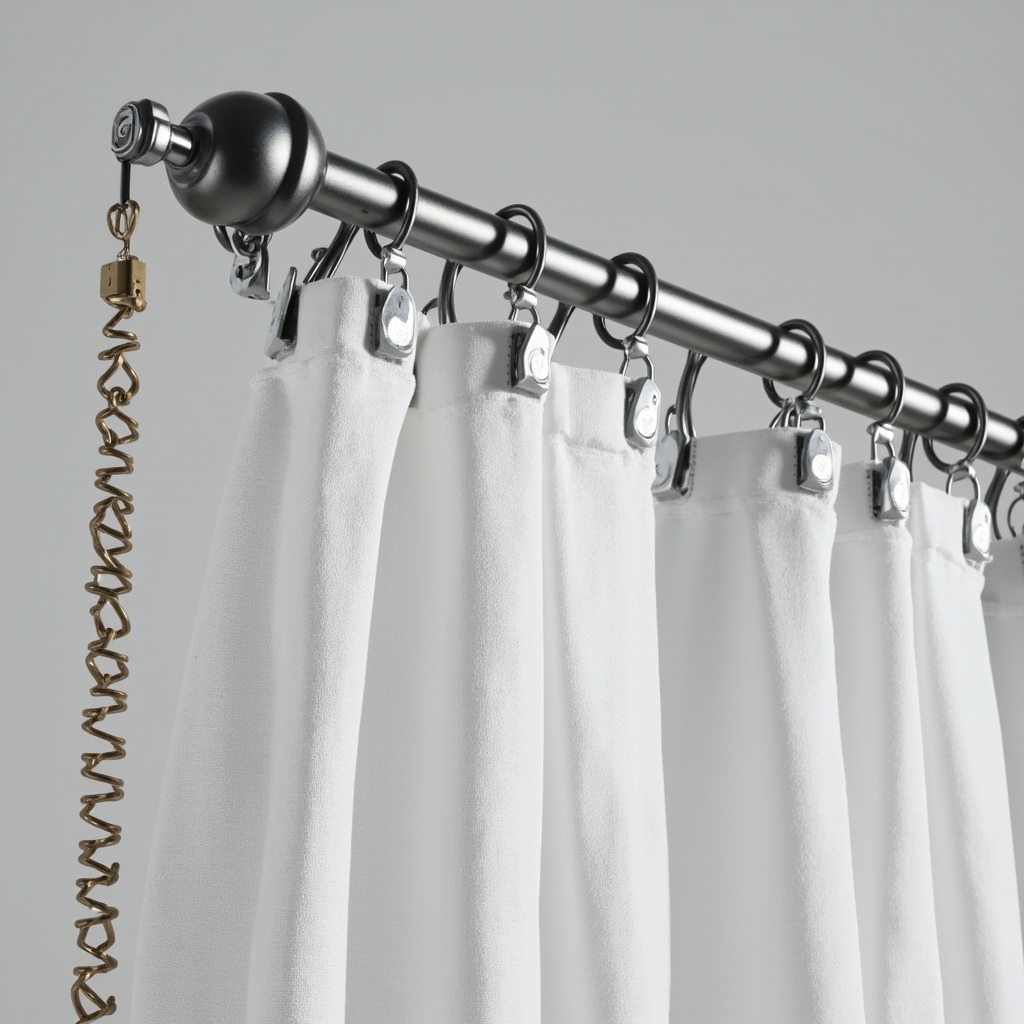
 Let’s be honest: nobody buys a curtain pole thinking about physics. You pick it up, you install it, you hang the drapes, and you hope it doesn’t sag. But if you’ve ever wrestled with a flimsy rod that bows in the middle or watched your heavy blackout curtains slowly drag the brackets off the wall, you know the real culprit isn’t your installation skills. It’s the weight distribution mechanics. And in telescopic Aluminum Alloy Curtain Hardware poles, this is where the magic—or the disaster—happens.
Most people assume a pole is a pole. It’s a tube. It holds fabric. Wrong. The genius of a well-engineered telescopic aluminum pole lies in how it manages the forces acting on it. When you extend a pole, you’re essentially creating a cantilever system at each joint. The locking mechanism isn’t just there to keep the length steady; it’s the critical point where load transfers from one section to the next. A cheap pole uses a thin-walled aluminum tube with a simple twist-lock that relies on friction alone. That’s a recipe for collapse. The moment you hang a heavy velvet curtain, the weight pulls downward, creating a bending moment that concentrates stress right at the joint. Friction gives up. The pole droops, the brackets groan, and you’re left cursing your purchase.
Now, here’s where premium telescopic aluminum poles separate themselves from the pack. The best designs use a multi-stage wall thickness strategy. The base section is thicker, often with a reinforced inner sleeve, to handle the highest bending stress near the bracket. As you telescope outward, each subsequent section is slightly thinner—but crucially, the overlap length at each joint is calculated to distribute the load evenly. This isn’t guesswork. It’s engineering. The locking cams are machined with precision grooves that bite into the aluminum, creating a mechanical lock that resists both rotational slippage and vertical shear. The result? A pole that can support up to 50 pounds of fabric without a hint of sag, even at full extension.
But let’s talk about the real game-changer: the center support bracket. Many telescopic poles come with a single bracket in the middle, but that’s a band-aid, not a solution. A truly advanced system integrates a hidden load-bearing rib inside the pole at the exact midpoint. This rib transfers the downward force directly to the bracket, bypassing the weakest part of the telescopic joint. Think of it as a backbone inside the tube. Combined with a tapered locking cone at the end of each section, the pole becomes a single, rigid unit rather than a series of wobbly segments.
For the marketing-minded reader, here’s the takeaway: your customers don’t care about torque or shear stress. They care about whether the pole will hold their curtains without looking like a sad smile. When you sell a telescopic aluminum pole, sell the confidence. Sell the fact that the weight distribution mechanics have been stress-tested to handle uneven loads, thermal expansion, and the occasional tug from a child or pet. Sell the fact that the locking mechanism won’t slip after six months of daily use. Sell the fact that the pole doesn’t just extend—it extends with integrity.
In a market flooded with cheap options, the pole that wins is the one that understands physics. Not as a buzzword, but as a promise. Weight distribution isn’t a feature. It’s the difference between a pole that works and a pole that works for years. Make that your story.